

Last Updated: October 23, 2026
Quick Summary
The best heated vest for extreme cold combines carbon-fiber heating zones over your core, battery capacity for long exposure, and insulation that traps warmth without bulk. A quality vest features five heating zones, three temperature settings, and a 12V 15,000mAh battery pack providing four to ten hours of heat depending on your setting.
- High heat settings reach 149°F or higher but drain battery in 2.5-3.5 hours in subfreezing conditions.
- Realistic cold-weather runtime on low setting is 6-8 hours, not the advertised 8-10 hours from room-temperature lab tests.
- Layer the heated vest outside your mid-layer and inside a windproof shell to maximize heat transfer and prevent moisture buildup.
- Always test your heated vest indoors before extreme-cold outings to verify all heating zones activate and battery connections are secure.
- Running high heat all day drains the battery in half the rated time; use low or medium for active hunting and save high for stationary periods.
Table of Contents
- What Makes a Heated Vest Work in Extreme Cold
- Heated Vest Temperature Settings: Finding Your Range
- Heated Vest Battery Life: Runtime and Capacity You Can Rely On
- Best Heated Vest for Hunting in Cold Weather
- Heated Vest Layering for Extreme Cold: Building Your System
- Durability, Maintenance, and Long-Term Performance
- Common Mistakes and How to Avoid Them
- Frequently Asked Questions
What Makes a Heated Vest Work in Extreme Cold
A best heated vest for extreme cold combines carbon-fiber heating zones over your core, battery capacity for long exposure, and insulation that traps warmth without bulk.
At Forest Field & Sky, our heated hunting jackets feature five carbon-fiber heating zones that deliver warmth, and the 12V 15,000mAh battery pack provides four to ten hours of heat depending on your setting.

Heated Vest Temperature Settings: Finding Your Range
Temperature control separates a usable heated vest from one that wastes battery. Most quality vests offer three heat settings.
Low settings typically reach around 105°F and consume minimal battery. Use this for moderate cold or when you're moving frequently and generating body heat.
Match your setting to your situation. Many people run high heat the entire time and burn through their battery in half the expected runtime.
Look for a discreet control panel you can adjust without removing gloves, and hidden indicator lights, bright LED displays can spook game.
Heated Vest Battery Life: Runtime and Capacity You Can Rely On
Battery performance determines whether your vest is a tool or a paperweight. A 12V 15,000mAh lithium-ion pack is the standard for serious heated apparel, translating to roughly four to ten hours of heat, but those figures come from room-temperature lab conditions, not a treestand at 10°F with wind.
Why Cold Weather Shrinks Runtime
Lithium-ion cells lose usable capacity as temperatures drop (Lithium-Ion Batteries under Low-Temperature Environment: Challenges and Prospects). A pack that delivers full rated runtime at 70°F can lose a meaningful share near or below freezing. Carrying the pack in an interior pocket helps. Plan for the low end of the advertised range and treat any runtime claim as a best-case ceiling.
Measured Runtime by Setting (What to Expect)
Advertised runtime is almost always quoted on the lowest setting. Here is the realistic pattern most users report when running a 15,000mAh pack in subfreezing conditions, with the pack carried in an interior pocket:
| Heat Setting | Advertised Runtime | Realistic Cold-Weather Runtime | Battery Drain Rate | Best Use |
|---|---|---|---|---|
| Low (~105°F) | 8-10 hours | 6-8 hours | Minimal | Active movement, moderate cold |
| Medium (~120°F) | 5-7 hours | 4-5 hours | Moderate | Stationary hunting, cold conditions |
| High (~149°F) | 4-5 hours | 2.5-3.5 hours | Maximum | Extreme cold, prolonged sitting |
Those cold-weather numbers are physics plus chemistry: higher temperatures demand more power, and cold cells deliver less. If a manufacturer quotes only one figure, assume it's the low-setting, room-temperature number and discount it.
Charging Time and Multi-Day Use
Charging time affects usability as much as runtime. An 8-hour recharge limits you to one charge per day unless you carry a spare; faster charging (4-6 hours via higher-output USB-C or a dedicated charger) is better for multi-day use. A USB output port drains the pack you need for heat, budget for it.
Replacement Batteries and Total Ownership Cost
The vest is the cheap part of ownership; the battery is the recurring cost. Before you buy, check three things:
- Included capacity. A vest bundled with a small pack (say, 10,000mAh) will not hit the runtimes above. Confirm the included pack's capacity, not just the vest's claimed hours.
- Replacement-battery price and availability. A proprietary pack that costs a large fraction of the vest's sticker price and is only sold by the manufacturer is a hidden ownership cost. Standardized or widely available packs are cheaper to replace and easier to source mid-season.
- Warranty on the pack. Batteries are the most common failure point. A one-year pack warranty is the floor; longer is better. Confirm whether the warranty covers capacity degradation or only outright failure.
Rule of thumb: if a replacement battery costs more than roughly a third of the vest's price and comes from only one source, factor that in. Two mid-priced swappable packs may beat one premium pack you can't replace.
Battery Status and Backup Planning
A digital display showing remaining power prevents surprises. Check the indicator before heading out and bring a backup pack for long days. For a full day of stationary hunting in extreme cold, assume you need a second pack or a plan to run medium instead of high for part of the day.
Best Heated Vest for Hunting in Cold Weather
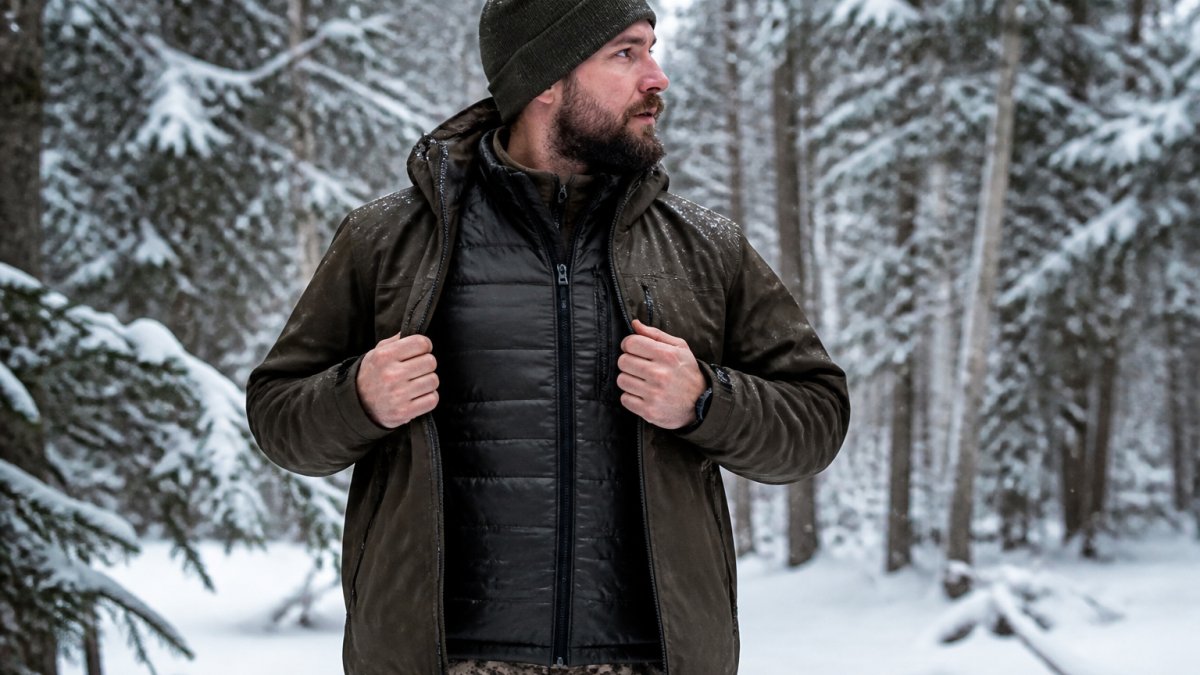
The Heated Hunting Jacket for Men from Forest Field & Sky is engineered for these demands. Five carbon-fiber heating zones cover your core and back.

Eight pockets store essentials without reaching for your pack. YKK zippers are included, the adjustable hood seals out wind, and silent movement technology keeps noise below 25 decibels.
The included 12V 15,000mAh battery fits in a jacket pocket, leaving your hands free and your profile unchanged. A digital display shows battery status at a glance.
Heated Vest Layering for Extreme Cold: Building Your System
A heated vest alone won't save you in extreme cold, the system matters more than any single piece. The biggest variable is whether you're stationary or generating heat through activity. Most layering advice treats those as the same problem. They are not.
The Four-Layer Stack, and What Each Layer Does
Start with a moisture-wicking base layer, merino wool or synthetic, never cotton, which holds sweat against your skin and kills insulation.
Next comes a fleece or synthetic mid-layer for insulation. This is the layer that traps the heat your body and the vest produce. Then your heated vest.
Heated Hunting Jacket for Men →
The order matters: the heated vest sits outside the mid-layer and inside the shell that holds that warmth.
Fit Tolerance: How Snug Is Too Snug
The heated vest should fit close against your body, not tight, but close enough that heat transfers to you rather than to empty air. Too much space and the elements warm the vest instead of you.
Avoid over-layering under the vest. One mid-layer is enough; excessive layers compress insulation and push the vest away from your body. If you're cold with a base layer, one mid-layer, and the vest on medium, the fix is a better shell or a higher setting, not another fleece.
Stationary vs. High-Output: Two Different Systems
The layering that keeps you warm in a treestand will make you sweat on a hike, and sweat is the enemy of warmth. Build the system around your activity level:
- Stationary (treestand, blind, ice fishing): Favor insulation and wind blocking. A thicker mid-layer, a windproof shell, and the vest on medium or high. You are not generating much body heat, so the vest is doing most of the work. Accept the higher battery drain.
- High-output (hiking, climbing, active scouting): Favor breathability and venting. A lighter mid-layer, a shell with pit zips, and the vest on low or off while moving. Turn the vest on when you stop. Carrying heat you don't need while moving just makes you sweat, and wet insulation is worse than no insulation.
- Mixed (commuting, working outdoors with intermittent activity): The hardest case. Use a shell with pit zips and a vest you can toggle quickly without removing gloves. Run medium while active, bump to high when you stop.
The Shell Is Not Optional
Your outer shell must block wind but breathe enough to prevent sweat buildup. A waterproof, windproof jacket with pit zips gives you temperature control, open them when active, close them when stationary. A shell without venting traps moisture and undermines everything underneath, including the vest.
Extremities and the Limits of Core Heat
A heated vest keeps your core warm, but hands and feet still need insulated gloves and boots rated for extreme cold. A warm core helps, since the body restricts blood flow to extremities when it senses core cold, but it does not replace them.
Durability, Maintenance, and Long-Term Performance
A heated vest is an investment. Proper care determines whether it lasts one season or five.
Carbon-fiber heating elements resist damage from normal use. The real wear points are the battery connection, control panel, and outer shell fabric.
Wash according to the manufacturer's instructions, most can be machine-washed on a gentle cycle.
Store the vest and battery separately during off-season.
The outer shell fabric will eventually wear through normal use. Small tears can be patched with fabric repair tape.
Common Mistakes and How to Avoid Them
Most heated-vest errors are easily preventable.
Mistake 2: Skipping the layering system. A heated vest isn't standalone. Without proper base and mid-layers, heat escapes and battery drains faster.
Mistake 3: Ignoring the battery. Batteries need care. Corrosion at the connector kills performance. Leaving a battery discharged for months degrades capacity.
Mistake 4: Wearing the vest too loose. A heated vest that fits like a regular jacket wastes heat warming empty space.
Mistake 5: Not testing before the hunt. The worst time to discover a battery problem is in the field.
Extreme cold is unforgiving.
The Heated Hunting Jacket for Men from Forest Field & Sky delivers on all three. It layers under your camouflage, stays silent in the field, and holds up to hard use. Explore the Collection and build your cold-weather system with gear designed for hunters who demand reliability when it matters most.
Frequently Asked Questions
How long does a heated vest battery last in extreme cold?
Battery runtime depends on heat setting and capacity. A 15,000mAh battery typically delivers 4-10 hours of heat depending on whether you use low, medium, or high settings. In extreme cold, high settings drain the battery faster. Expect 4-6 hours on high, 7-9 hours on medium, and up to 10 hours on low. Carrying a spare battery extends your time outdoors significantly.
What temperature settings should I use for extreme cold conditions?
Most heated vests offer three settings: low (around 105°F), medium (around 120°F), and high (around 149°F). In extreme cold, start on medium to balance warmth and battery life. Switch to high only during prolonged exposure below 0°F or when stationary for extended periods. Low settings work for mild cold or as a battery-saver during active movement when body heat supplements the vest.
Can you wear a heated vest under a winter coat for hunting?
Yes, and it's the recommended approach for extreme cold. Layer the heated vest under your insulated hunting jacket to trap warmth and protect the heating elements. The outer jacket blocks wind and moisture while the heated vest provides core warmth. Ensure the outer layer isn't so tight that it restricts blood flow or compresses the heating zones, which reduces effectiveness.
Are heated vests durable enough for regular hunting and fishing use?
Quality heated vests with reinforced seams, waterproof shells, and machine-washable construction hold up well across seasons. Carbon-fiber heating elements are more durable than older wire designs. Key durability factors: avoid overheating (most vests have overheating protection), don't overcharge batteries, and follow washing instructions carefully. Expect 2-3 seasons of regular use before considering replacement, depending on care.
