

Last Updated: November 2, 2026
Quick Summary
Choose quiet hunting camo by starting with soft fabric: brushed fleece, soft-shell, or heavy knit absorb sound, while slick nylon and crisp ripstop are the loudest. Test fabric by rubbing and crumpling it near your ear, then check zippers, drawcords, and pocket flaps for noise. Match the pattern to your terrain and buy for the way you actually hunt.
- Rub a sleeve against itself and crumple it near your ear to test fabric noise in the store.
- Fleece is the quietest fabric but the least weatherproof; soft-shell blocks wind with moderate noise.
- Hook-and-loop closures make one of the loudest, sharpest sounds on a garment and carry far.
- Water-resistant fabric is not waterproof, so carry a true rain shell for sustained rain.
- Cold weather stiffens fabric, so break in cold-weather layers before the season.
Table of Contents
- Start With the Fabric: The Best Fabric for Quiet Hunting Clothes
- Match the Pattern to Terrain, Season, and Light
- Hunting Camo for Moving vs Sitting: Two Different Jobs
- Check the Garment Components, Not Just the Fabric
- Quiet Waterproof Hunting Gear: What You Give Up and What You Keep
- Layer for Changing Temperatures Without Adding Noise
- Keep Gear Quiet Through Care, Wear, and Cold Weather
- Build Your Quiet Camo Kit at Forest Field & Sky
- Frequently Asked Questions
Start With the Fabric: The Best Fabric for Quiet Hunting Clothes
The best fabric for quiet hunting clothes is a brushed fleece, soft-shell, or heavy knit that absorbs sound instead of reflecting it.
Here is the rule that matters: the softer the hand, the quieter the cloth. Run your palm across a sleeve.
Quiet hunting camo starts with material, not pattern. A perfect color scheme on noisy fabric still gives you away the moment you shift your weight.
Fleece, Soft-Shell, and Knit: How Each One Sounds
Fleece wins on silence. Its brushed surface traps air and kills the rustle that comes from stiff fibers rubbing together.
Soft-shell sits in the middle. It blocks light wind and sheds a drizzle, but the face fabric can get chatty when it folds.
Knit is the sleeper pick. A tight knit hoodie moves with you and stays quiet, though it offers less weather protection.
- Fleece: quietest, warmest, least weatherproof
- Soft-shell: moderate noise, good wind block
- Knit: quiet and stretchy, light on protection
A Fabric-Noise Test You Can Run in the Store
You do not need gear to test fabric noise. Use your hands and your ears.
- Grab a sleeve in each hand and rub the fabric together, fast, like you are walking.
- Crumple a section near your ear and listen for a crunch.
- Fold the jacket at the elbow and swing your arm to hear the crease.
- Rub the sleeve against your side, since that is how fabric moves on a stalk.
If you hear a crisp snap, expect that sound to carry. If it stays soft, you have a keeper. Penn State Extension wildlife notes on deer senses explain how heavily deer rely on hearing, which is why this test earns its place.
Here is how the three main quiet fabrics stack up on sound and weather protection.
| Fabric | Noise level | Weather protection |
|---|---|---|
| Fleece | Quietest | Least weatherproof |
| Soft-shell | Moderate noise | Good wind block, sheds a drizzle |
| Knit | Quiet and stretchy | Light on protection |
Match the Pattern to Terrain, Season, and Light
Match the pattern to the ground you actually hunt, not the catalog photo. Colors that blend in one setting can glow in another.
Start with your dominant backdrop:
- Greens and browns for mixed hardwood and early foliage
- Grays and tans for late season, bare ground, and sage
- Dark timber patterns for heavy cover and shadow
Light changes the game. Morning and evening sun flatten contrast, so mid-tone patterns hold up better than high-contrast ones.
The goal is to break up your outline.
Quiet hunting camo works best when the pattern disappears into the terrain you sit in most.
Hunting Camo for Moving vs Sitting: Two Different Jobs
Hunting camo for moving vs sitting are not the same purchase. When you sit still, pattern and silhouette do the work. When you move, sound and motion give you away. But "moving vs sitting" is too coarse a split to buy gear by. Still-hunting, stalking, treestand hunting, and bowhunting each expose different sounds, and the right quiet-camo setup changes with the method.
Match Quietness to Your Movement Level
Think of movement level as a scale, not a switch. The more you move, the more every fold, closure, and loose strap matters.
- Treestand and ground-blind sitting: You move least, so pattern and silhouette carry the load. Bulkier, warmer layers are fine because the fabric barely folds. Prioritize a backdrop-matching pattern and a quiet seat and rest, and keep calls, snacks, and rangefinders in quiet pockets you can open without a rip.
- Bowhunting from a stand: You move more than a rifle sitter, and you move at the worst time. Drawing a bow folds the shoulder, elbow, and chest fabric and can drag a sleeve across the riser or rest. Favor stretch panels at the shoulders and elbows, snug cuffs, and a chest pocket that does not slap when you draw. Test the draw motion in the store, not just the walk.
- Still-hunting: You take slow steps, pause, and listen. Every step folds fabric at the knee, hip, and waist, so quiet cloth is non-negotiable. Favor soft, brushed fabrics, fewer loose straps and dangling cords, snug cuffs and hems that do not flap, and quiet closures over loud hook-and-loop.
The Sounds Each Method Exposes
- Sitting: Zipper pulls, pocket flaps, and any hardware that taps when you shift your weight or reach for gear.
- Bowhunting: Shoulder and elbow fabric folding on the draw, sleeve drag, and chest-pocket or call-lanyard slap.
- Still-hunting: Knee and hip folds on each step, hem and cuff flap, and cord swing.
A common mistake is buying a great stationary setup, then trying to stalk in it. The gear fights you the whole way. Buy for the method you actually hunt most, and keep a lighter, quieter layer set for the days you plan to move.
Check the Garment Components, Not Just the Fabric
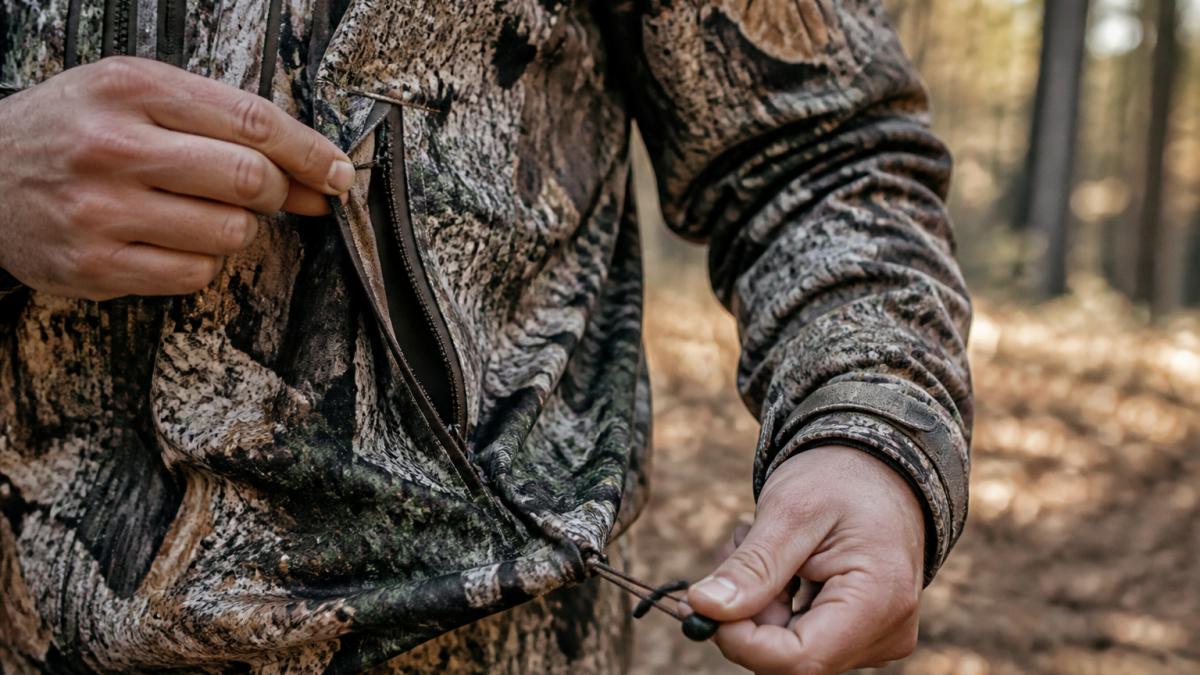
The fabric is half the story. Zippers, drawcords, and pocket flaps make their own noise, and they often betray you first. Most quiet-camo advice stops at "pick soft fabric," which is why so many hunters buy a silent jacket and still get busted by a zipper pull or a swinging cord.
Where the Sound Actually Comes From
- Zipper sliders and pulls: Metal sliders rasp against the teeth, and free-hanging pulls jingle and slap the jacket when you walk or raise an arm. A zipper guard keeps the slider off your chin and off hard surfaces.
- Hook-and-loop closures: The rip of hook-and-loop is one of the loudest, sharpest sounds on a garment, and it carries. Pocket flaps, cuff adjusters, and call pockets are common offenders.
- Drawcords and toggles: Loose cord ends swing and tap against the shell with every step. Cord locks click when they knock together.
A Component Sound Check Before You Buy
Run this in the store, in the same order every time, so you can compare garments fairly:
- Zip test: Open and close every zipper slowly, then quickly. Listen for rasp and for the slider hitting the guard or your chin.
- Pull test: Hold the jacket by the shoulders and shake it gently. Free-hanging pulls and cords will announce themselves.
- Pocket test: Open and close each pocket flap and closure. Note whether it uses hook-and-loop, a snap, or a quiet magnetic or covered closure.
- Cord test: Tuck the drawcords as you would in the field, then swing your arms. Any cord that swings free will tap.
- Fold-and-swing test: Bend at the waist and swing your arms to hear linings, seams, and flaps rub.
- Hardware test: Tap the buckles and D-rings against the shell and against each other.
A garment that passes all six is a keeper. One that fails any single test will fail it in the woods, usually at the worst moment.
Hunting Jacket for Men Quiet Hunting Camouflage Clothing Hoodie Camo Coat →
What to Look For Instead
- Zipper pulls that do not jingle or slap, or that tuck into a garage
- A zipper guard so the slider never touches your chin
- Drawcords that tuck away, not swing free
Our quiet hunting pants show what to look for: a partly elastic waist and a soft interior, with multiple pockets. Inspect the components the same way you inspect the cloth, and test them in the order above so a loud zipper cannot hide behind a quiet shell.

Quiet hunting camo lives or dies on these small parts. A silent jacket with a screaming zipper is still a loud jacket.
Quiet Waterproof Hunting Gear: What You Give Up and What You Keep
What you keep: dry shoulders in a steady rain and a wind block that cuts the chill.
What you give up: some of the silence, plus breathability if the shell is heavy.
The practical answer is a two-part system. Our windproof hunting suits guide walks through how to balance weather protection against noise.
Watch out: water-resistant fabric is not waterproof.
Layer for Changing Temperatures Without Adding Noise
Layering keeps you warm without forcing one loud, heavy coat. The trick is to build from quiet base layers up, so nothing in the stack crinkles.
A simple system:
- Base layer: soft, snug, and silent against the skin
- Mid layer: fleece or knit for warmth
- Outer layer: quiet camo that blocks wind and sheds light rain
Choose layers that slide over each other without grabbing. Fabric that sticks and releases makes a ripping sound when you move.
For a full breakdown of the stack, our complete layering system guide covers each layer in depth.
Keep Gear Quiet Through Care, Wear, and Cold Weather
New gear is quiet. Gear that has been washed wrong, snagged on brush, or frozen stiff is not.
Cold weather makes fabric stiffer. A jacket that whispers at room temperature can crackle at dawn in freezing air.
A few habits keep noise down:
- Wash with a gentle detergent and skip the fabric softener
- Air-dry instead of tumbling on high heat
- Repair snags and pulls before they stiffen
Durability and quietness go together. A jacket that holds its soft finish season after season stays silent. One that stiffens and pills gets louder every trip.
Build Your Quiet Camo Kit at Forest Field & Sky
Building a quiet kit comes down to three checks: soft fabric, smart components, and a pattern that fits your terrain. Get those right and you stop spooking game before you ever raise your bow or rifle.
Our hunting jacket for men pairs a soft interior with underarm ventilation zippers, an adjustable roll-up hood, and a zipper guard.

Ready to put the checks to work? Explore the full quiet hunting clothes suit and build a kit that stays silent from the trailhead to the stand.
The hardest part of quiet hunting camo is not finding gear. It is finding gear that stays quiet through movement, weather, and a full season of use.
Frequently Asked Questions
What makes hunting camo quiet?
Quiet hunting camo comes down to three things: the fabric surface, how the garment is built, and how it fits. Brushed or fleece-like outer fabrics rub against each other with far less rustle than hard nylon. Covered zippers, soft drawcords, and snug cuffs stop small parts from clicking or flapping. A fit that leaves room for layers also prevents fabric from pulling tight and scraping as you move. Pattern matters for concealment, but noise is what gives your position away before the pattern ever gets tested.
What is the best fabric for quiet hunting clothes?
Brushed fleece and soft-shell fabrics with a matte, textured face are the usual picks for the best fabric for quiet hunting clothes. They absorb sound rather than reflecting it, and they stay quiet when brushed against brush or tree bark. Smooth, tightly woven nylon and polyester shells are louder but shed water better. Many hunters keep a quiet fleece or soft-shell set for still days and a louder waterproof shell for rain, accepting the trade-off only when the weather forces it.
How can you test hunting clothes for noise before buying?
Rub a sleeve against the body of the jacket in the store and listen for a crisp swish versus a dull hush. Crumple a cuff near your ear, then open and close every zipper and pocket flap. Bend your arms across your chest the way you would drawing a bow. Ask a companion to stand a few feet away and rate the sound. Any snap, click, or scrape you hear at arm's length will carry much farther in cold, still air, so treat it as a warning sign.
Can waterproof hunting gear be quiet?
Quiet waterproof hunting gear exists, but it usually trades some breathability or adds weight. Waterproof membranes need a tightly woven face fabric, which tends to be louder than fleece. Brushed soft-shell pieces with a water-repellent finish handle light showers quietly, while a fully waterproof shell is best saved for steady rain. Forest Field & Sky's quiet hunting jacket and pants use a water-resistant exterior for light showers and are not fully waterproof, so plan a rain shell for sustained wet weather.
